Note to Mr. Bradley
Thirteen Reasons WhyThe note to Mrs. Bradley is Hannah Baker’s understated, repeatedly rewritten attempt to make her thoughts about suicide visible without identifying herself. Placed in a classroom paper bag meant for feedback and discussion topics, it becomes both a disclosure and a test of whether the adults and classmates around Hannah can recognize a warning when it arrives indirectly.
The note and its setting
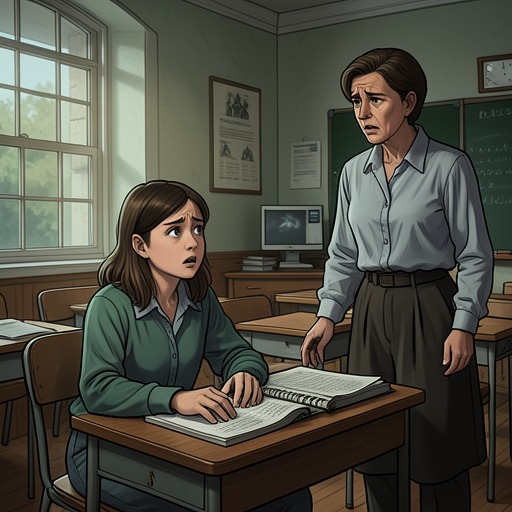
At the back of the class, Mrs. Bradley kept a paper bag hanging on the spinning bookrack with the students’ bags. Students could leave comments about her teaching, critical or otherwise, and she encouraged them to suggest subjects for future discussions. Hannah used this ordinary classroom channel to write the word “Suicide” and say that it was something she had been thinking about, though “not too seriously.” The note is not presented as a detailed plan; its significance lies in the fact that Hannah chose to name the subject at all.
The apparent casualness of the wording contrasts with the effort behind it. Hannah says she wrote the note dozens of times before delivering it, repeatedly composing and discarding drafts. She explains that the thought of suicide did come to mind, but that she pushed it away rather than considering it in detail. Calling the note a lie therefore captures an important tension: she minimized the thought even as she kept returning to the act of writing it and ultimately left it for someone else to find.
A disclosure without a name
The note gave Mrs. Bradley a topic for class discussion, but it did not identify its author. After Hannah’s classroom meltdown, Mrs. Bradley read it to the class the following day. Hannah believed Zach Dempsey knew she had written it, yet he did not reach out to her, even after the teacher raised the note. In retrospect, the paper’s anonymity did not mean that no one could connect the message to a person; rather, the people who might have recognized Hannah’s distress did not turn recognition into contact.
The class’s response exposed the limits of the invitation to speak. Students had previously submitted topics including abortion, family violence, and cheating, without being pressed to reveal who proposed them. When the topic was suicide, however, one student argued that the writer merely wanted attention and should have identified themself if they were serious. That demand shifted attention from the warning to the credibility of the unknown writer. Hannah concluded that there was no way for her to open up in that class.
What the class did—and did not—learn
Mrs. Bradley spent about ten minutes presenting local statistics. She explained that suicides involving juveniles might not be reported in the news if they did not occur in a public place with witnesses, and that families might describe a death as an accident rather than disclose what happened. The result, she said, could be that people in a community did not know what others were facing. The information widened the subject beyond the anonymous note, but it did not lead to the thorough discussion the class needed.
The contrast is central to the note’s role in the story: suicide was discussed in general terms while the possibility that the message came from a student in the room remained unresolved. The class wanted specifics, but its demand for identification made disclosure harder; its discussion supplied statistics without creating a clear opening for Hannah to speak privately. The note thus records an attempt to seek attention and help, while also showing how institutional procedure and peer skepticism can leave a warning legible as a subject but unheard as a personal appeal.
A warning read in retrospect
The note gains further weight alongside other signs that Hannah’s distress was visible but not acted upon. A few days before she took pills, she returned to greeting people in the halls and looking them in the eyes after months of behaving differently. The apparent return of the “real Hannah” seemed drastic to others, but it did not prompt Zach to approach her. The classroom note and the change in her behavior together reveal a gap between noticing signs and responding to them.
Later, Hannah’s actions and conversations make the risk more explicit: she gave away her bicycle, and she described a plan involving pills and a final day at school. She also tried to communicate that she wanted life to stop, and during a conversation with Mr. Porter she was asked directly whether an incident with a boy might have been illegal. These later moments do not change what the note says; they show why its cautious wording matters. It was an early, imperfect disclosure, not proof that Hannah had no serious distress. As an object, the paper bag made a route for student voices available, but leaving a message there could not ensure that anyone would recognize its author’s need or follow through with support.